Who is the B1Ggest, and who is SECond?
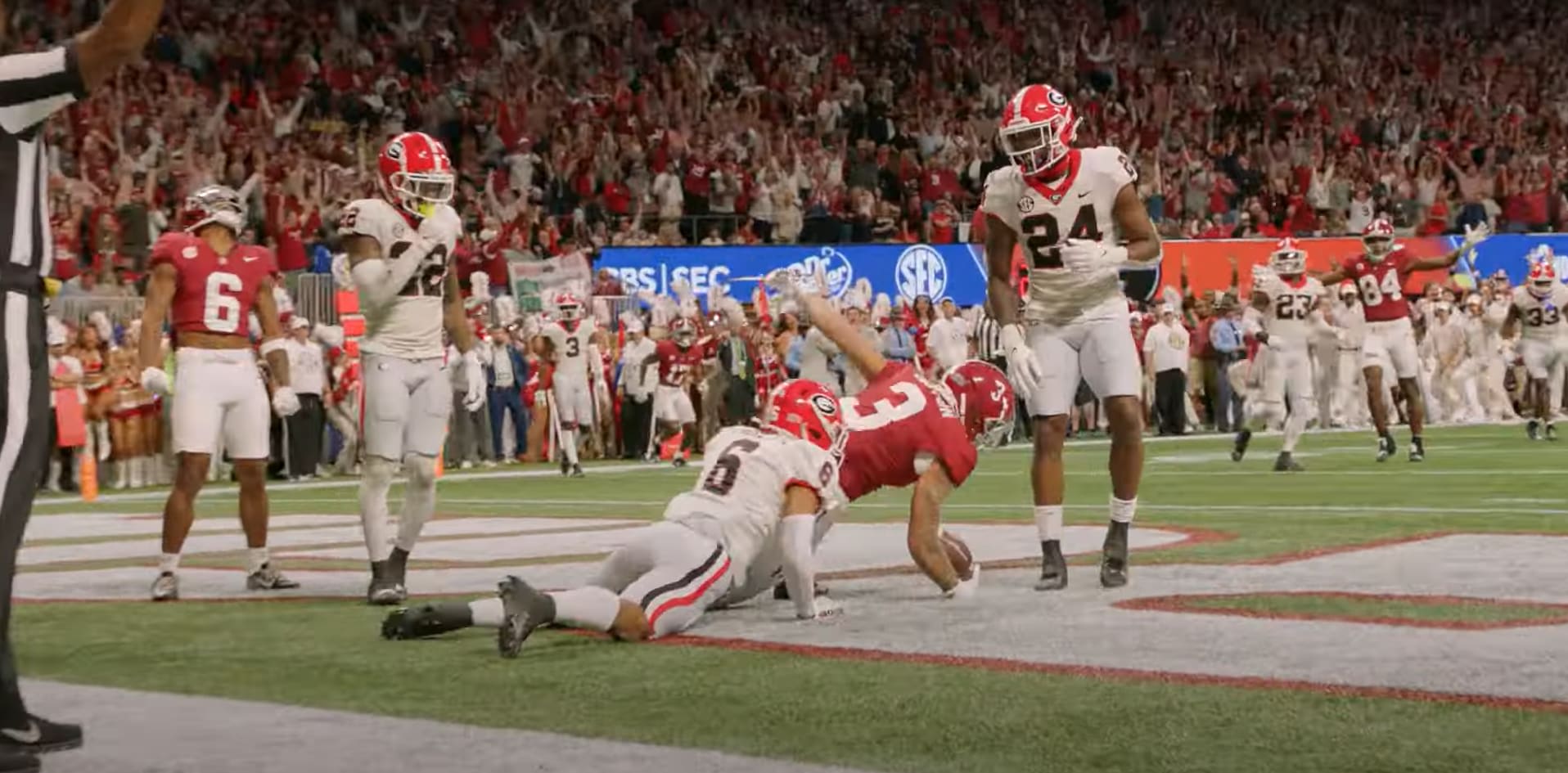
What is the best conference in college football? A question that was once as easy to answer as “Who was the best singer in the Jackson 5?” has now become a lot more like “Who was the best artist in Young Money?” There are two right answers, and all the others are very wrong. For years, the SEC was the undisputed top dog, as evidenced by its seven consecutive BCS championship wins from 2006–2012. Now, the B1G (pronounced Big Ten), fresh off its third consecutive national championship, each won by a different team, has many people questioning whether the South still reigns supreme.
If we were to answer this question purely based on who has won the most championships, I believe the SEC still has a very strong claim to being number one. For starters, it has won 14 of the last 25 national championships, not including then-Big 12 member Texas’ 2005 run. In that span of time, the SEC had streaks of seven and, more recently, four in a row. In comparison, the B1G only has five championships. Not to mention, there was a 12-year drought between numbers one and two and a nine-year drought until the next one after that. So, while B1G fans love to use championships as their main argument, I don’t believe it is a very strong one at all.
I do think B1G fans are right to focus on the present moment more than the past, especially given the ever-changing landscape of college football. We don’t live in the world we were born into, and that is nowhere more evident than in college football (I was born in ’98, for context). We’ve gone from Reggie Bush giving back his Heisman Trophy over a loaner car to a multimillion-dollar bidding war over 19-year-olds every winter. So, to judge who the best conference is today based on an antiquated world is foolish. I believe the best way to judge the conferences in a system that incentivizes players to move freely from school to school is to look at one calendar year at a time.
Now, this only solves half the problem. Another major change in today’s CFB world is superconferences. If we look back again at the last 25 champions, USC and Texas are both on that list, and neither of those teams belongs to the conference it did when it won its title. After the dissolution of the Pac-12 and the exits of Texas A&M, Texas, and Oklahoma from the Big 12 (thank you, Longhorn Network…), the SEC and B1G both became flooded with not only talent but also member schools. Believe it or not, at one point, the 10 in Big Ten was representative of the number of schools, but I guess the Big 18 just isn’t as catchy. The SEC was smart not to hamstring itself by adding a number to its name. Although, the Southern 16 has a bit of a ring to it. Nonetheless, these are two giant conferences, both headlined by giant programs. So, how do we evaluate that many teams against each other? We don’t.
The easiest way to measure who is better pound for pound is to split each conference in half and weigh the top halves against each other. No disrespect to the bottom halves, but this is an argument about the best of the best, not the best of the worst. The best way to decide the top halves? The last calendar year. So, this will be based on where each team finished in its respective conference last season.
Indiana, Ohio State, Oregon, Michigan, USC, Iowa, Illinois, Minnesota, Washington.
Georgia, Alabama, Ole Miss, Texas A&M, Texas, Oklahoma, Vanderbilt, Missouri.
Even with this super-advanced scientific method, this isn’t easy. If we look at the top four teams in each conference, I think that, team for team, the B1G is the stronger of the two. But starting at USC and Texas, things take a turn. Texas was the best 9–3 team last season, and many people would argue it should’ve been in the playoffs. No one would say the same for USC or even Michigan, which Texas beat in a bowl game. This is where the difference in the depth of the conferences starts to become very evident. In this comparison, the SEC had five teams make the CFP compared to the B1G’s three. Indiana would go on to win it all and be the clear best team in the country, but the SEC did not perform as poorly as a lot of people remember. For starters, two SEC teams were eliminated by their own conference mates (there was only one B1G vs. B1G matchup). So, although the B1G is better at the very top of the conferences, once you go a little farther down the rankings, the SEC is still stronger.
So, what matters more? The depth of the conference or the cream of the crop? Well, that’s up to everyone to decide for themselves. For me, I tend to lean toward the depth of the conference. However, if you asked me which conference has more title contenders and a better chance to raise the trophy in January, I’d tell you the B1G for sure. Now, these are all just hypotheticals and talking points until the ball gets spotted. I believe Texas and Ohio State are the two most talented teams in the country (hurry up, September 12), but there are several teams in each conference that will have something to say about that over the course of this year. One thing is for sure: We can expect a playoff littered with teams from these two juggernaut leagues.